Dean’s Distinguished Fellowship supports life-changing student experience — and potentially, life-saving science
When Joe Toce ran a biochemistry company in St. Louis over two decades ago, one elusive molecule stood out. His team had long sought to synthesize it — a small organic compound with big potential to revolutionize blood-thinning medications used to prevent strokes, heart attacks and chronic conditions like deep vein thrombosis.
Current anticoagulant therapies, while effective, come with significant drawbacks: some must be administered by injection, while others are irreversible or take hours to activate — issues that can cost lives in emergency situations. The compound Toce envisioned could change that. Taken orally and fast-acting, it could fill a critical gap in patient care.
Years later, after retiring and becoming a long-time donor and supporter of UWL student research and science education, including support of the Dean’s Distinguished Fellowship (DDF) program, Toce brought that question — and the promise of that molecule — to UWL.
“He approached me at a DDF event,” recalls Robin Grote, associate professor of Chemistry & Biochemistry at UWL. “He explained the molecule and the medical need behind it. That’s how the project was born.”
From lab to medical school
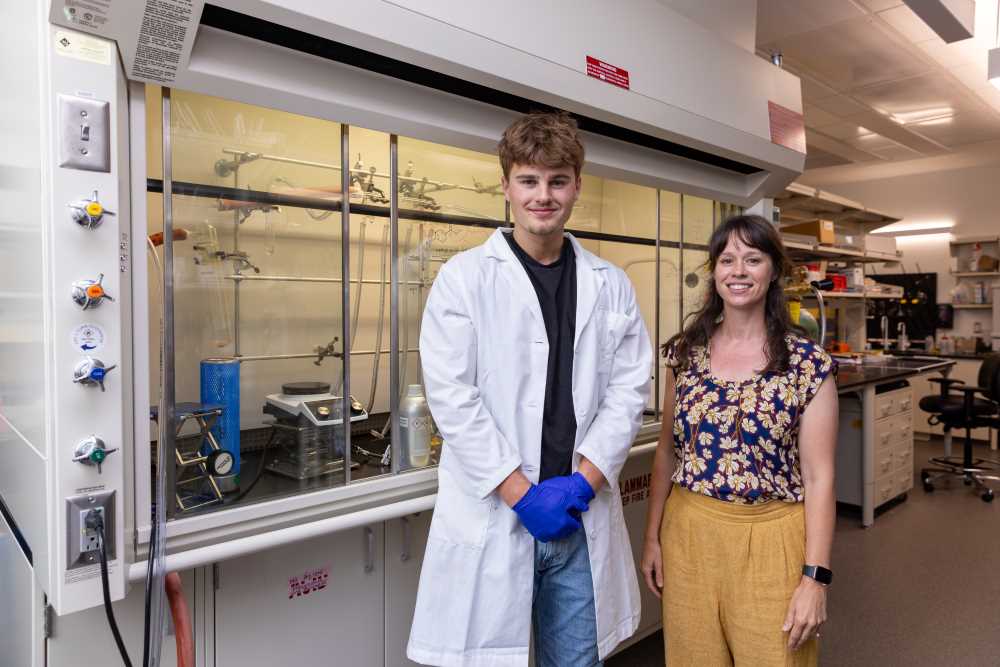
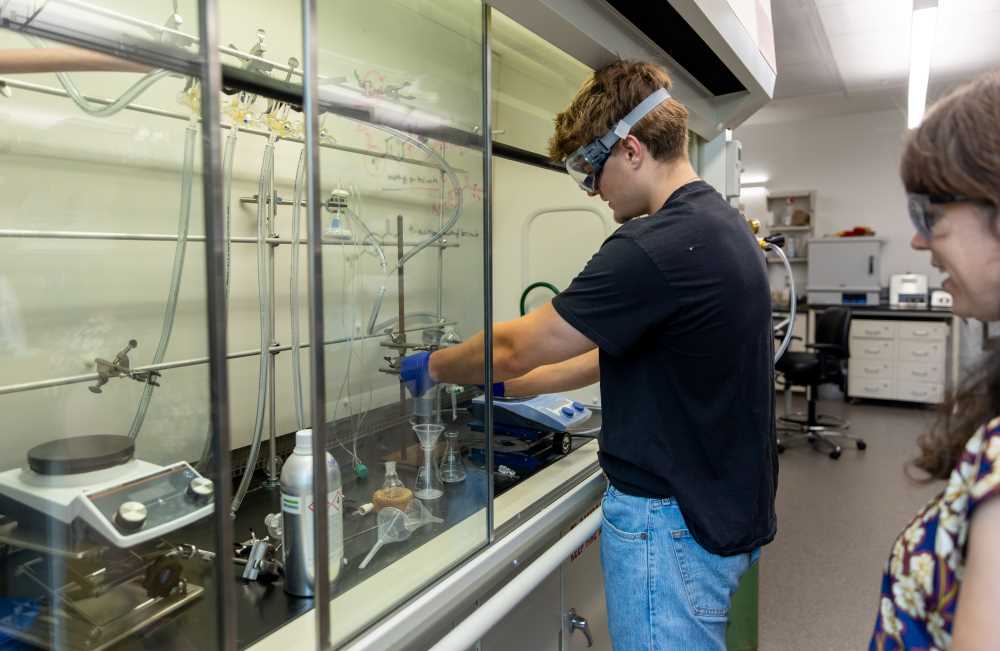
This summer, Grote and biology major Roman Domashevsky took on the challenge of synthesizing this molecule through the DDF program — a prestigious summer research experience that pairs undergraduates with faculty mentors. For Domashevsky, the opportunity is more than just a résumé builder; it’s an early step toward his goal of becoming a physician.
“Since shadowing my dad — who’s an ER doctor — I’ve known I want to work in that kind of environment,” says Domashevsky. “It’s fast-paced, and you’re in a position to make someone’s day or life better. That’s incredibly valuable to me.”
Domashevsky’s experience preparing for medical school reflects exactly what Drs. Joe and Suzanne Toce hoped to support when they decided to donate to the Dean’s Distinguished Fellowship program.
Investing in the future
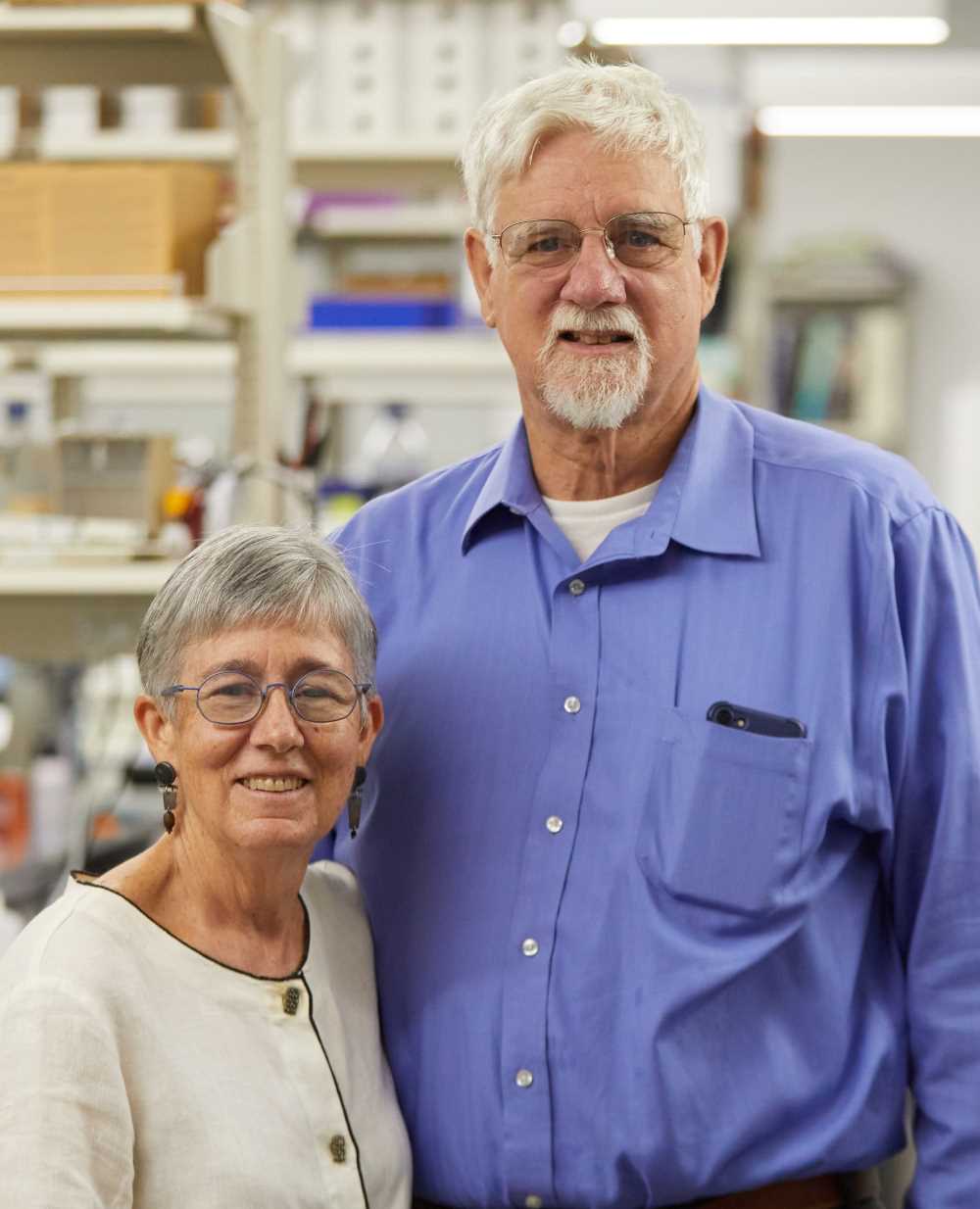
“I don’t think of it as donation,” says Suzanne regarding their gifts to the DDF program. “I think of it as investment. You are investing in the future.”
The Toces have seen the impact of their support firsthand. During a recent cardiology visit, a medical student recognized Joe.
“He told the doctor, ‘He funded my summer research to get into medical school,’” Toce recalls. “That’s why we do this. It’s a way of helping students move forward.”
Their connection to UWL runs deep. Joe once taught part-time in the Chemistry & Biochemistry Department and has since encountered several former students — now working as respiratory therapists, physician assistants, and more — during hospital visits at Emplify Health. “If you teach at the university and go to the hospital, you will see former students,” he says.
They hope their support helps students get a foot in the door to their future career.
Real research, real results
While contributing to a novel research project, Domashevsky is gaining hands-on lab experience rarely accessible to undergraduates at larger institutions.
“I’ve been really blessed to have this experience,” he says. “At big schools, it can be nearly impossible to land a research spot as an undergrad. Dr. Grote reached out to me and made it easy to get involved — and it’s been a huge step in preparing for medical school.”
Grote says she selected Domashevsky for her fellowship project because he showed initiative early on — asking about research opportunities after class during his freshman year. Though her lab was full at the time, she remembered his interest and contacted him the following semester when her DDF project was nearly ready to launch.
Since June 1, the two have been collaborating in the organic chemistry lab inside UWL’s Prairie Springs Science Center, starting with the most obvious synthetic pathways and gradually working toward more creative approaches to building the molecule.
“All students find it a little intimidating at first — being in charge of a chemical research project sounds overwhelming,” says Grote. “But Roman is starting to realize he knows what he’s doing. He’s building confidence and working more independently. It’s great to watch that growth — and especially meaningful given his medical aspirations.”
The research, which will likely continue into the academic year and possibly involve other student researchers, is still in early stages. But Grote says the process itself — asking good questions, experimenting and learning from setbacks — is the heart of scientific inquiry.
And for Domashevsky, the experience has already been transformative.
“Last summer I was a lifeguard, outside all day,” he laughs. “This is a complete change — but I love it. Working in the lab with Dr. Grote is genuinely fun. And I’ve made real connections with the other students. We’ve become friends.”
Grote, who joined UWL as a new faculty member in Fall 2023, says mentoring in the DDF program was a priority from the start.
“A huge part of the mission of a tenure-track professor is to help undergraduates find their footing in research,” she says. “The DDF program gives students a stipend for their time, plus professional development — training in research ethics, applying to graduate programs and more. It is a fantastic program. They don’t just do research — they join a community of learners.”
Watch the video of Roman describing his research.
About the Dean’s Distinguished Fellowship (DDF) Program
For over 20 years, the Dean’s Distinguished Fellowship has offered select students in UWL’s College of Science and Health a transformative summer research experience. Under the guidance of faculty mentors, fellows explore scientific and scholarly projects that prepare them for careers in research, healthcare, technology and beyond.
- More than 350 DDF alumni now work in science, medicine, and technology around the world.
- Over 200 have gone on to earn advanced degrees — including 80+ with doctoral degrees.
This prestigious program is made possible by the support of generous donors. Fellowship support starts at $5,500 — covering research stipends and professional development that shape futures.
Support the next generation of scientists and healthcare professionals. Learn more about the DDF program.
Written by UW-La Crosse
Link to original story: https://www.uwlax.edu/news/posts/a-molecule-with-medical-promise/